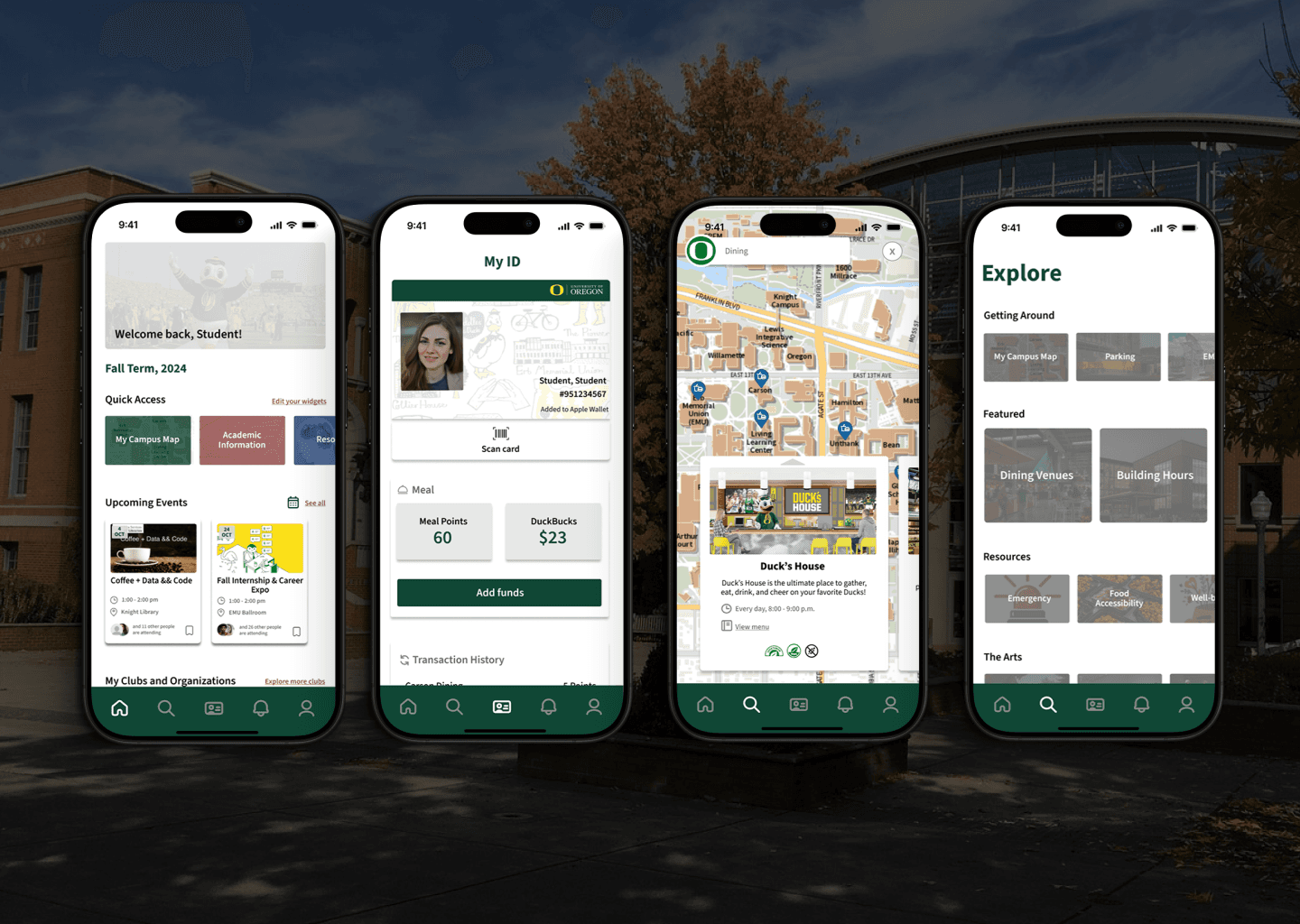
UOregon App
Date
Sept - Oct 2024
Role
UX Designer
Team
Solo Project
Tools
Figma, Figjam
SUMMARY AND IMPACT
I led the end-to-end research and redesign of the UOregon app to address a core issue: students weren’t struggling with features, they were struggling with fragmentation. Through interviews, card sorting, competitive analysis, and usability testing, I uncovered how students navigated campus through disconnected systems: physical IDs, DuckWeb, external browsers, and separate apps. I restructured the app into a centralized ecosystem that unified dining, events, academics, safety, and mobile ID into one seamless platform.
The redesign improved task completion, clarified navigation, and reduced friction in everyday campus moments.
↑
100%
Task Success
↓
29%
Navigation Time
↑
86%
User Satisfaction
Overview
THE ISSUE
Research
COMPETITIVE AUDIT
Mobile ID embedded
Adding in meal points with mobile ID + access to buildings
Building hours + map
Calendar of events
Resource page
SURVEYS & INTERVIEWS
I interviewed 4 University of Oregon students and 1 University of Oregon employee to gain further insight into using a physical ID card.
Sample Question:
How would you describe your past and current experience with using a physical ID?
Users use the UOregon app to check their class map and find no use of other features within the app.
Users have a preference for a mobile ID
SYNTHESIS
Users emphasized the need for convenience and easier access to resources when using their ID.
PERSONAS
To understand the needs of my participants, the participants I interviewed fell into two categories that represent the primary user groups: the involved student and the new employee.
IDEATION
While I have received insight into my users mental models and behavior toward using a physical ID card, I wanted to dig deeper and gain insight that I didn’t get through the initial interviews.
I found that students want to have a full college experience without feeling excluded from school events and resources, which will reduce the risk of FOMO.

Prototyping
WIREFRAMING
I sketched out wireframes before initializing them on Figma. Due to a tight timeframe, I went straight from sketching low-fidelity frames to creating high-fidelity frames.
I also believe these frames communicate all the features that my participants have emphasized having on a mobile app, hence confirming my decision to go directly to high-fidelity frames after hand-drawing them.
WIREFRAMING

Testing
REVISIONS
To summarize, all 5 participants have noted that the app has a clean interface and is easy to navigate. However, there were some feedback and concerns about the app which I had addressed and made several iterations below.
Issue 01 - Visibility Issue with Slider
My participants ignored the slider feature, missing out on more information about the dining hall. To increase the visibility, I changed the slider to an arrow and included instructions to swipe up for first-time users.
Issue 02 - Importance of Features
My participants have emphasized moving the “Emergency” card toward the front of the “Resources” slider as it is easily seen and accessible to students who need it. The “Emergency” card is now towards the front instead at the tail-end of the resources slider.
REFLECTION
Key Takeaways
For my first case study, I learned and exposed myself to various UX research methods and learned how to manage a project under a time constraint. This project allowed me to practice a structured design process, enhancing my design-thinking process.
Testing early is important: While I felt confident to move from lo-fi frames and hi-fi frames, I often stared at the screen too long trying to figure out which elements made sense where. Gathering feedback earlier in the process would’ve helped me save time, while also validating my users needs and implementing their feedback.
Recruiting diverse users: Most of my participants were upper-classmen and lived off-campus. While it was impactful to hear about their experiences during their freshman year or their time living on campus, my research might have yielded results that I may not have expected by interviewing current freshmen and on-campus students.


