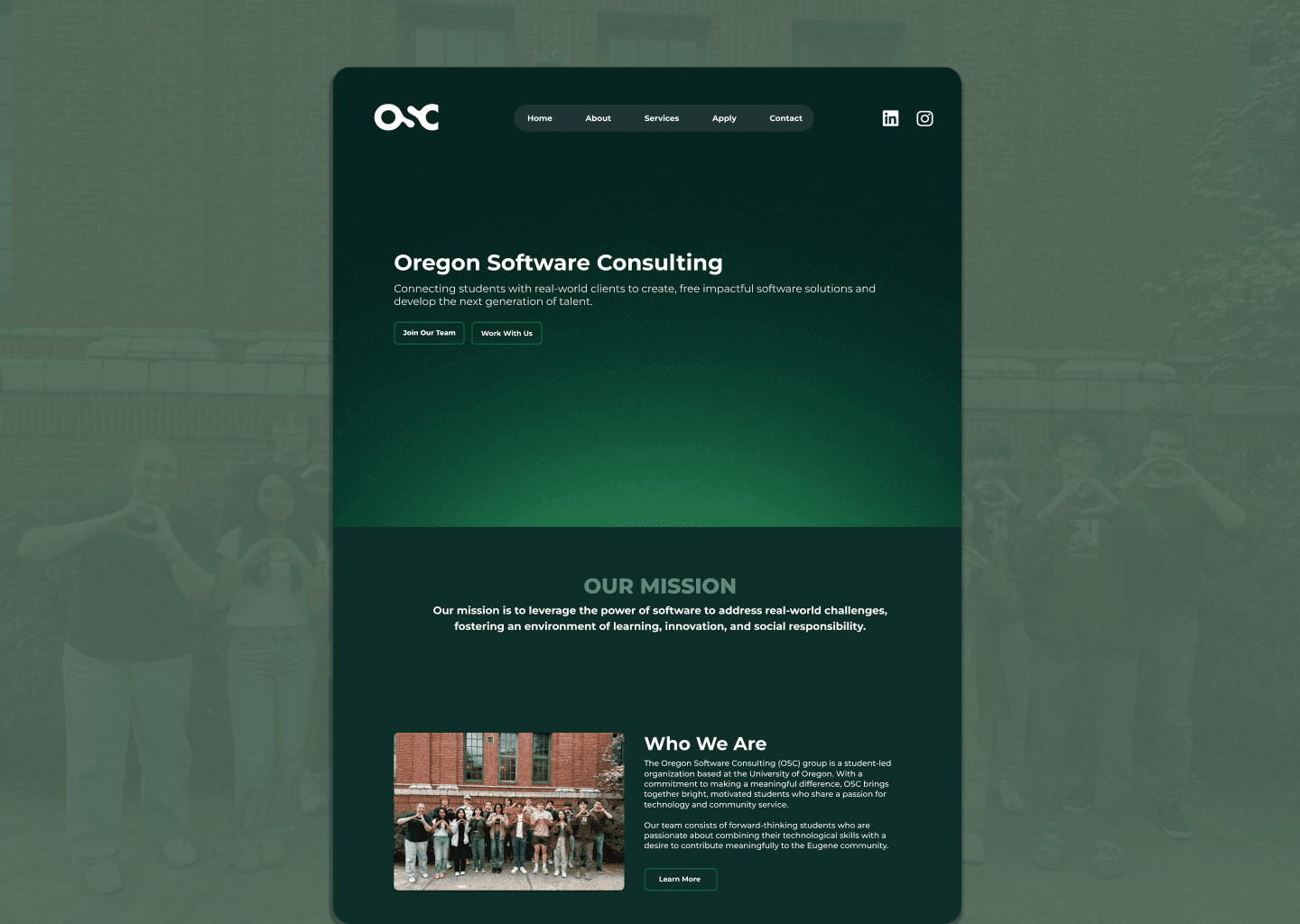
App Screen with open sidebar

Redesigning Trust for a Student-Led Tech Consultancy

Redesigning Trust for a Student-Led Tech Consultancy

Oregon Software Consulting

Oregon Software Consulting

Oregon Software Consulting

Oregon Software Consulting (OSC) is a new, student-led software consulting group. As a new student-led organization, OSC faced a trust deficit. I led a redesign to transform skepticism into engagement.. This project focused on creating a professional website to establish trust, showcase services, and strengthen our brand identity. Visit the live site: https://www.oregonsoftwareconsulting.com/

Date

Jan - Feb 2025

Role

Lead UX Designer

Team

Kristie Chu (UX Designer) Drew Moulton (Developer)

Tools

Figma, Figjam

SUMMARY AND IMPACT

I led the UX strategy and design overhaul to reposition OSC as a legitimate, reliable, and human-centered consultancy. This wasn’t just a visual refresh, it was a strategic intervention. Through competitive audits, user interviews, and iterative testing, we uncovered what builds trust in tech organizations: clarity, transparency, and emotional resonance. I translated these insights into a new information architecture, visual system, and interaction model that elevated OSC’s brand and unlocked engagement.

Through iterative design and usability testing, the redesign significantly improving overall user experience.

45%

Task Success

67%

Navigation Time

64%

User Satisfaction

Overview

THE ISSUE

OSC lacked a credible online presence, making it difficult to attract clients and student members.

OSC lacked a credible online presence, making it difficult to attract clients and student members.

OSC lacked a credible online presence, making it difficult to attract clients and student members.

When I joined Oregon Software Consulting, I saw potential, but also a problem. Despite the team’s talent and ambition, our online presence did not match this. Clients hesitated. Students overlooked us. We weren’t just missing conversions, we were missing trust.

Core issues identified by our users:

Who is OSC?

Who is OSC?

Who is OSC?

What services are offered?

What services are offered?

What services are offered?

Why would anyone hire/trust us?

Why would anyone hire/trust us?

Why would anyone hire/trust us?

PROBLEM STATEMENT

How might we build trust that encourages clients to hire us and students to join OSC?

How might we build trust that encourages clients to hire us and students to join OSC?

How might we build trust that encourages clients to hire us and students to join OSC?

Research

COMPETITIVE AUDIT

What Makes an Organization Trustworthy and Reliable?

What Makes an Organization Trustworthy and Reliable?

What Makes an Organization Trustworthy and Reliable?

We compared OSC against 4 other student consulting/tech groups. Trust-building patterns emerged:

Clear service descriptions

Visible team page

Testimonials or portfolio of past work

Transparent timelines and expectations

Consistent branding and visual identity

SURVEYS & INTERVIEWS

Understanding services should be simple and clear, however it's not..

Understanding services should be simple and clear, however it's not..

Through surveys with 30 participants and interviews with 7, we identified distinct needs for students and clients, and where their frustrations overlapped.

Through surveys with 30 participants and interviews with 7, we identified distinct needs for students and clients, and where their frustrations overlapped.

🎓 Students Needed

🎓 Students Needed

🎓 Students Needed

Clear meeting times, application cycles, goals, engaging activities.

💼 Clients Needed

💼 Clients Needed

💼 Clients Needed

Contact info, past work, list of services, rough pricing

⚠️ Shared Pain Points

⚠️ Shared Pain Points

⚠️ Shared Pain Points

Vague or missing info, disorganized navigation, lack of credibility (lack of stats, testimonials, project work, etc)

Vague or missing info, disorganized navigation, lack of credibility (lack of stats, testimonials, project work, etc)

COMPETITIVE AUDIT

What's causing friction in our current design?

What's causing friction in our current design?

What's causing friction in our current design?

Participants struggled to find even basic information. They felt lost and confused: they didn't know what OSC offered and who we were.

Participants struggled to find even basic information. They felt lost and confused: they didn't know what OSC offered and who we were.

Insight:

Insight:

Users wanted specifics (services, people, past work) presented in a professional, engaging design.

Insight:

Users wanted specifics (services, people, past work) presented in a professional, engaging design.

SYNTHESIS

Two primary needs emerged:

Two primary needs emerged:

Through surveys with 30 participants and interviews with 7, we identified distinct needs for students and clients, and where their frustrations overlapped.

Information First

Information First

Information First

Participants and clients emphasized that services, team, and structure must be explicit.

Participants and clients emphasized that services, team, and structure must be explicit.

Trust Through Design

Trust Through Design

Trust Through Design

Participants noted the importance of consistent branding and credibility markers (portfolio, testimonials)

Participants noted the importance of consistent branding and credibility markers (portfolio, testimonials)

PERSONAS

Meet Alejandro and Sarah:

Meet Alejandro and Sarah:

Meet Alejandro and Sarah:

One representing students seeking professional growth, and another representing clients in need of reliable tech support. Creating these personas helped humanize our data, guiding our design decisions with real motivations and pain points in mind.

USER JOURNEY MAPS

How might we help users understand our mission?

How might we help users understand our mission?

How might we help users understand our mission?

By visualizing each step of their journey from discovering the club to contacting us or joining, we identified key opportunities to make the experience clearer, more trustworthy, and more engaging.


We found that these elements could be a target focus to improve the experience for students and clients:

  • Adding portfolio of our work

  • Adding a team member page

  • Simplifying jargon while being specific about our services

Prototyping

WIREFRAMING

Wireframing the Experience

Wireframing the Experience

After defining key opportunities from our research and journey maps, and finalized the information architecture, we began sketching low-fidelity wireframes to visualize layout ideas and information hierarchy. These early wireframes helped us quickly test content structure and navigation before investing in visuals.

WIREFRAMING AND USER FEEDBACK

Initial Testing with Our Users

Initial Testing with Our Users

Once we aligned on the flow, we refined them into mid-fidelity prototypes to validate usability and content clarity with users. Through testing our mid-fi prototypes, participants emphasized the need for:

Clearer explanations of our club’s purpose and services.

Clearer explanations of our club’s purpose and services.

Clearer explanations of our club’s purpose and services.

Better balance between information for clients and students.

Better balance between information for clients and students.

More interactive elements to create a sense of engagement.

More interactive elements to create a sense of engagement.

WIREFRAMING

Polishing the Final Frames

Polishing the Final Frames

Once we aligned on the flow, we refined them into mid-fidelity prototypes to validate usability and content clarity with users. Through testing our mid-fi prototypes, participants emphasized the need for:

Testing

REVISIONS

How does our audience feel about our updated site?

How does our audience feel about our updated site?

All 6 participants have noted that the app has a clean interface and is easy to navigate. However, there were some feedback and concerns about the app which we had addressed and made several iterations below.

Issue 01 - Lack of Clarity

Despite our changes from initial testing, some information under the “Apply” section lacked clarity to convince students to join us. We fixed this by adding an impactful and informative description for each header.

Issue 02 - Wait... Your Services are Free?

Our client participants emphasized the need to center the client and our work for clients; they highlighted that we should put our emphasis on our free consultation services throughout the website.


We fixed this by emphasizing our free services in the “Home” page and “About” page.

NOTABLE QUOTES

What Our Participants Had to Say:

What Our Participants Had to Say:

“I really like the humanistic aspect of the website. I feel like some technological organizations can be too computerized and I like how this website has more of a human-touch.”

“I really like the humanistic aspect of the website. I feel like some technological organizations can be too computerized and I like how this website has more of a human-touch.”

“I really like the humanistic aspect of the website. I feel like some technological organizations can be too computerized and I like how this website has more of a human-touch.”

“I was hesitant when I first visited the old website, but i feel more inclined to join after looking at the new website.”

“I was hesitant when I first visited the old website, but i feel more inclined to join after looking at the new website.”

“I was hesitant when I first visited the old website, but i feel more inclined to join after looking at the new website.”

REFLECTION

Key Takeaways

I really enjoyed this project since I got to do brainstorming sessions with the other designer, Kristie (also shout-out to our developer, Drew for developing the website within a day or two and for working around our design-thinking). Being able to constantly gather feedback from users was an impactful experience for me to leverage in my future projects. Here are some takeaways I had:

  • Balance your users: It’s important to remember to balance your users when designing for multiple audiences. Without realizing, I was prioritizing designing for students, but had to remind myself to also forefront the needs of clients.


  • Asking the right questions: We had several hiccups interviewing users since we did not go over these questions with others beforehand. To ensure a smooth process interviewing/testing, it’s good to go over the questions with non-users prior to asking users. By doing so, we can get insightful and valuable answers by adjusting and fixing our questions as needed.